South African restaurants have undergone a quiet but permanent transformation since 2020. What started as a survival tactic during lockdown (moving orders online to stay alive) has become a structural pillar of how the country eats. Mr D Food and Uber Eats together now process millions of orders every month across Cape Town, Johannesburg, and Durban. For a well-positioned restaurant in the City Bowl or the Winelands, online orders can account for 25 to 40 percent of total revenue. That is not a supplementary channel anymore. That is core business.
The problem is that most restaurants are running their online and in-house operations as two entirely separate systems, and paying for that separation in ways that rarely appear on a single line of their P&L. The real cost is distributed: in the extra staff hour spent transcribing tablet orders into the POS, in the refund issued because the kitchen made a dish that had sold out online thirty minutes earlier, in the reconciliation session that eats up a Friday afternoon. Integrated online ordering fixes all of this and, in doing so, unlocks revenue that standalone platforms cannot capture on their own.
The Real Cost of Standalone Ordering Platforms
Standalone delivery platforms give you reach. Customers find you, browse your menu, and place orders. But unless that platform connects directly to your POS, every order arrives as a notification on a tablet, and someone on your team has to manually re-enter it into your system. In a service with 20 covers and 15 online orders during a Friday dinner rush, that person is not doing anything else while they type. They are a bottleneck, and bottlenecks are where errors breed.
Double entry creates double the opportunities for mistakes. A modifier gets missed ("no onion") and the dish goes out wrong. An item runs out in your kitchen but remains live on the platform because no one updated it in time. A customer gets charged for something unavailable and wants a refund. Your kitchen team fires a dish that was never meant to be cooked. Each of these micro-failures costs money directly, and repeated enough, they cost you reviews and repeat customers too.
"Every order that travels through a human intermediary instead of a direct system connection is an order at risk of an error, a delay, or a missed modifier."
TimeWorks: Restaurant Operations Insights
At month end, the reconciliation problem becomes acute. Your POS reflects in-house sales. Your delivery platform dashboards reflect online sales. Your bank reflects net payouts after commission deductions. Tying these three sources together manually: matching order IDs, accounting for platform fees, reconciling against stock consumed, is a minimum two-hour exercise for any operator doing meaningful online volume. That is time that belongs to running the restaurant.
What POS Integration Actually Means
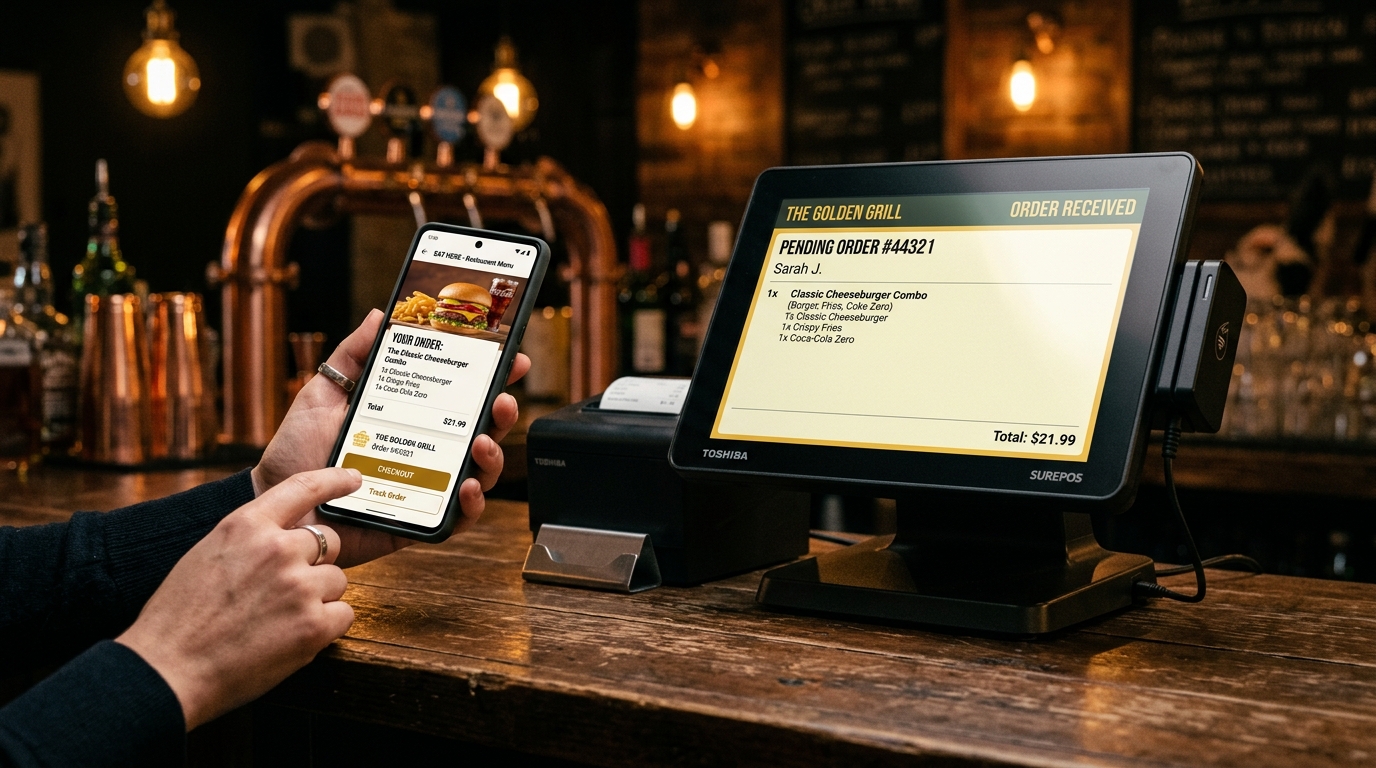
When your online ordering platform is integrated with your POS, a customer placing an order on Mr D Food or Uber Eats, or on your own branded ordering page, does not trigger a tablet notification that waits for a human. It triggers an order in your POS system in real time, exactly as if a table had ordered it. The kitchen receives a KDS ticket. Stock is decremented. The order joins the queue. No re-keying, no intermediary, no delay.
From the kitchen's perspective, an online order and a table order are indistinguishable: they arrive the same way, with the same modifiers, the same priority flags, the same timing logic. This is the operational core of what integration delivers: a single source of truth for everything your kitchen produces, regardless of where the order originated.
| Factor | Standalone Platform | POS-Integrated |
|---|---|---|
| Order Entry | Manual re-keying required | Automatic: flows directly to POS |
| Stock Sync | Manual update on 86 items | Real-time: sold out items hide automatically |
| Kitchen Dispatch | Separate tablet, separate queue | Single KDS queue: all orders unified |
| Modifier Accuracy | Dependent on transcription | Customer input maps directly to kitchen |
| Reconciliation | Manual: 2+ hours per week | Automatic: included in daily reports |
| Refund Rate | Higher: errors reach customers | Lower: errors caught at source |
The Revenue Impact
The operational case for integration is clear, but the revenue story is equally compelling, and less obvious. Customers ordering online consistently spend more than customers ordering in person. Without the social pressure of a server waiting at the table, without the menu fatigue of a busy dining room, online customers browse longer, add extras more freely, and select higher-margin items more often. Industry data from comparable markets shows average online ticket values running 15 to 30 percent above the equivalent in-house average.
Integration amplifies this because it enables menu features that standalone platforms cannot properly execute. Upsell prompts ("Add a side for R35") are consistent and accurate because they reflect actual stock. Bundle deals are enforced correctly because the POS applies the same rules it uses in-house. Time-limited specials toggle off automatically at the POS level rather than requiring a manual platform update that someone may forget at 6pm on a Saturday.
Fewer errors translate directly into fewer refunds. Refunds on delivery platforms carry double costs: the lost food cost, and the platform processing friction. A restaurant doing 200 online orders a week with a 3 percent error rate is processing six refunds. At an average order value of R180, that is R1,080 per week in lost revenue, plus the platform fee already deducted. Integrated ordering, by eliminating the manual re-entry stage, eliminates the most common root cause of those errors entirely.
Operational Benefits Beyond the Numbers
Real-time stock synchronisation is the feature operators appreciate most once they have it. When your POS knows that the last portion of the line fish sold at table 12 four minutes ago, that information is immediately available to every ordering channel. The online menu updates. The platform listing hides the item. A customer attempting to order it online sees it as unavailable, not as an item that arrives with an apology phone call from the driver. In Cape Town's restaurant scene, where seasonal menus and daily specials are a selling point, this matters constantly.
Payment reconciliation shifts from a weekly chore to an automatic output. Your integrated POS captures the gross order value, the platform commission, and the net payout for every online order. At the end of the day, your sales report includes online and in-house totals in a single view. Your accountant's job becomes simpler. Your cash flow picture becomes clearer. VAT reporting becomes less fraught.
Load Shedding and the Offline Queue Problem
South Africa has a layer of complexity that does not feature in any international guide to online ordering integration: load shedding. When Stage 4 arrives at 6pm on a Friday (peak delivery window), restaurants face a specific risk. Cloud-only systems that require a live internet connection to accept and process orders go dark. Orders in transit fail. Drivers arrive for collections that were never confirmed. Customers post one-star reviews about missed orders.
A properly implemented integration architecture handles this through an offline order queue. When connectivity drops, incoming online orders are held in a local queue and pushed to the POS the moment the connection restores, without duplication, without data loss, and without requiring any intervention from floor staff. This is not a feature you should assume is included. It is a capability you should confirm explicitly before choosing an integration solution, particularly in South Africa's infrastructure environment.
TimeWorks POS systems are designed for offline-first operation. The SQL backend runs locally and syncs to the cloud when available, meaning your in-house ordering never stops regardless of connectivity. When paired with an integration layer that implements the same queuing logic for incoming online orders, you have a system that survives a load shedding event without a single missed order.
Platform Options in the SA Market
In South Africa, the delivery platform landscape is effectively a two-player market. Mr D Food (Naspers-backed, dominant in Cape Town and deeply embedded in South African consumer behaviour) and Uber Eats (strong in Johannesburg, growing rapidly in Cape Town and the Western Cape) together account for the vast majority of food delivery volume. Both publish APIs and actively encourage restaurant integrations: they want orders fulfilled accurately and quickly, and integration serves that goal.
Beyond the aggregators, there is a growing appetite among SA restaurants for branded direct ordering: a custom ordering page at your own domain, without platform commission on every sale. Direct ordering via your own channel costs a flat monthly fee rather than 20 to 30 percent per transaction, and builds your customer database rather than the platform's. For restaurants doing meaningful online volume, the commission saving on direct orders typically funds the integration cost within three to four months.
A well-integrated POS handles all three channels (Mr D Food, Uber Eats, and direct ordering) through a single interface. Menu updates made in the POS propagate to all platforms simultaneously. Price changes apply everywhere at once. New items appear on all channels when you publish them, not when you remember to update each dashboard individually.
How the Integration Works
There are three common architectural approaches to connecting an online ordering platform with a POS system, each with different trade-offs on reliability, cost, and complexity.
-
Direct API Connection The platform and POS communicate natively via published APIs. This is the most robust approach: no intermediary, lowest latency, real-time bidirectional sync. Requires the POS vendor to have built and maintained the specific integration. TimeWorks supports direct API connections with major SA delivery platforms.
-
Middleware / Integration Hub A third-party middleware service (such as Deliverect or a local equivalent) sits between the platform and the POS, translating between their data formats. Useful when a direct integration is unavailable, but introduces a dependency on the middleware provider's uptime and pricing structure.
-
Native POS Plugin Some POS platforms offer a built-in online ordering module: a branded ordering page hosted by the POS vendor, with full native integration. This is the simplest setup for direct ordering and gives maximum control over the customer experience, menu presentation, and promotional tools without touching a third-party platform.
A Real-World Scenario
Consider a mid-sized Cape Town restaurant in Gardens: 60 covers, averaging 180 in-house transactions per day plus 55 online orders, with online representing about 30 percent of daily revenue. Before integration, two staff members shared the responsibility of watching the delivery tablet, re-entering orders, and updating the delivery platform when items sold out. The kitchen operated two parallel queues (in-house KDS tickets and printed delivery orders), which created sequencing confusion during peak service.
After integration, the delivery tablet is replaced by the existing KDS. Online orders appear in the kitchen queue within seconds of being placed. The POS automatically decrements stock on completion, removing the need for manual 86 updates. End-of-day reporting consolidates all channels in a single report that the owner reviews in fifteen minutes rather than ninety. The two staff members previously assigned to order management now focus on service. The restaurant's modifier error rate on online orders dropped from an estimated 4 percent to under 0.5 percent in the first month, eliminating approximately R800 per week in refunds.
The more significant change was in online order volume. Without the operational constraint of managing a parallel workflow, the restaurant was comfortable promoting their delivery channels more aggressively. Online orders grew by 18 percent in the first quarter post-integration, not because the integration conjured demand, but because the operation was now capable of handling it without penalty to in-house service quality.
Getting Started with TimeWorks Online Ordering Integration
Setting up integrated online ordering with TimeWorks begins with an assessment of your current online footprint: which platforms you are live on, your current order volumes, your menu structure, and your kitchen dispatch workflow. From there, we configure the integration layer, map your menu items and modifiers to the platform formats, and run a parallel-operation test period to confirm accuracy before cutting over fully.
The typical setup timeline for a restaurant already on Mr D Food or Uber Eats is five to ten business days. For a restaurant setting up online ordering for the first time (including a branded direct ordering page), allow two to three weeks for menu photography, platform onboarding, and integration testing. We handle the technical configuration; your team focuses on the menu content and the photography.
Ongoing management is minimal once the integration is live. Menu changes made in the TimeWorks POS backend propagate to all connected channels automatically. Platform-specific promotions (such as Uber Eats boost campaigns) can still be configured at the platform level and will pull through the correct pricing. The integration does not constrain your promotional flexibility: it simply ensures that whatever you set up works consistently across every channel.
See Integrated Online Ordering in Action
We will walk you through a live demo of the TimeWorks online ordering integration, showing you exactly how Mr D Food and Uber Eats orders flow into your POS, how stock sync works in real time, and what your reconciliation reports look like when everything is in one system.